

.jpg?width=500&height=500&name=stefan-stefancik-5p_7M5MP2Iw-unsplash%20(1).jpg)
What's So Exciting About HubSpot's New AEO Tool?
If you’re a small or mid-sized B2B company trying to figure out AI search, it’s easy to think you’ll never be able to compete with the big brands. You’re probably thinking, They have more money, more resources, more staffing, and more content. How are we ever supposed to compete with something like that? What chance does a company like mine have?
According to the surprisingly good Greenfire Strategy AI Citation study, the AI citation landscape isn’t actually dominated by a handful of enormous brands. It’s fragmented and unexpectedly wide open. While it's reasonable to assume AI search is rigged for the big guys, we’re pleased to report the data doesn't show that.
TL;DR Takeaways
|
The HubSpot Paradox
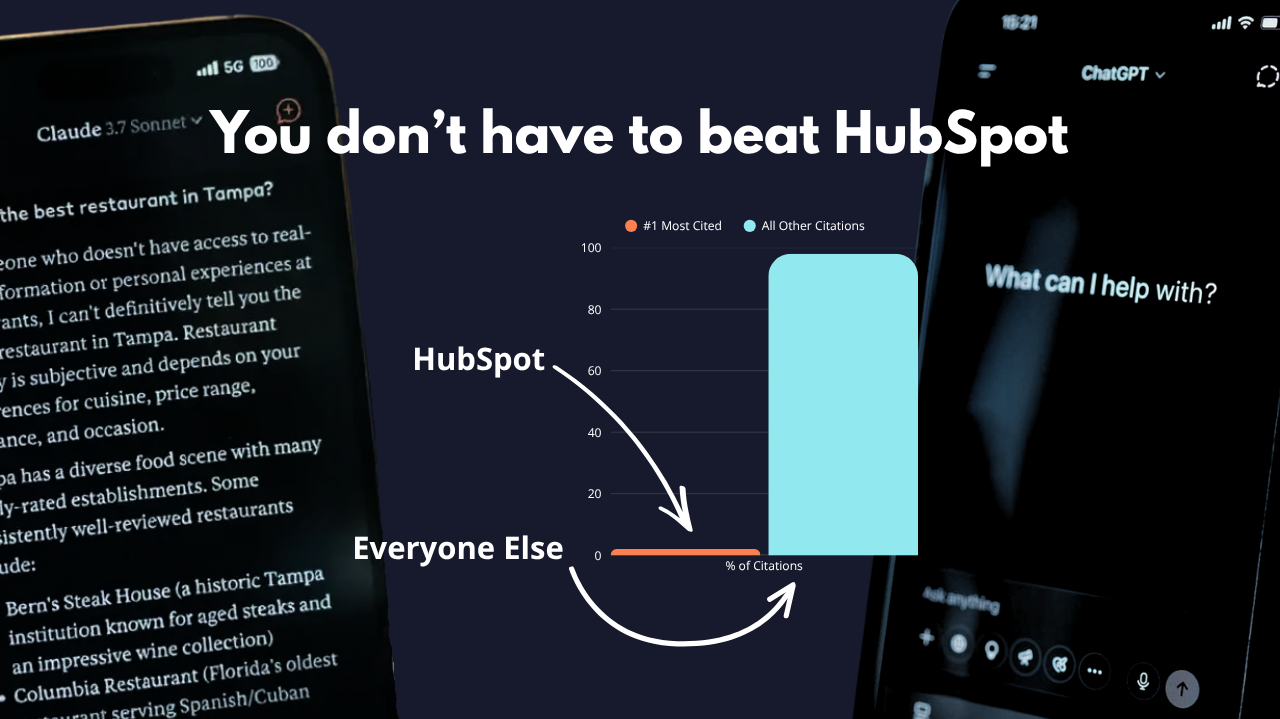
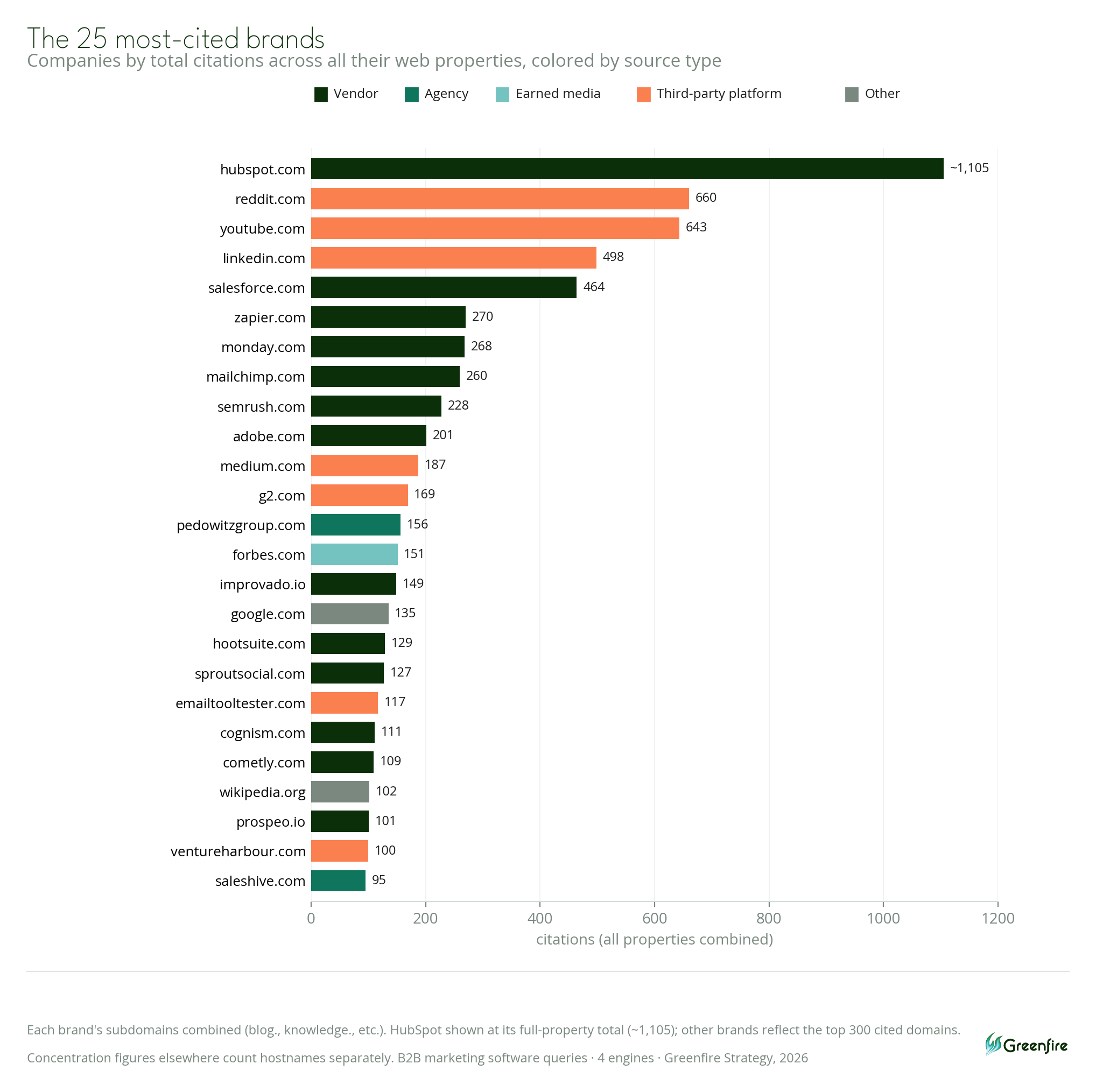
HubSpot is the #1 cited brand in the Greenfire Strategy AI Citation Study, with roughly 1,105 citations. Despite being the top brand for our query, they still hold under 2% of the total citations. If the most-cited company in the dataset still represents less than 2% of citations, that means no single company dominates the field.
Since we now realize there isn’t one huge company sitting at the top and absorbing most of the visibility, that changes the question for smaller companies. Instead of asking, “How do we beat HubSpot (or any other large company)?” the question becomes “Where can we become one of the best answers?”
With AI citation visibility being distributed across an enormous amount of sources, becoming the leader or having a huge brand doesn’t mean controlling the market. In fact, HubSpot’s relatively small share is evidence of how fragmented the citation landscape actually is.
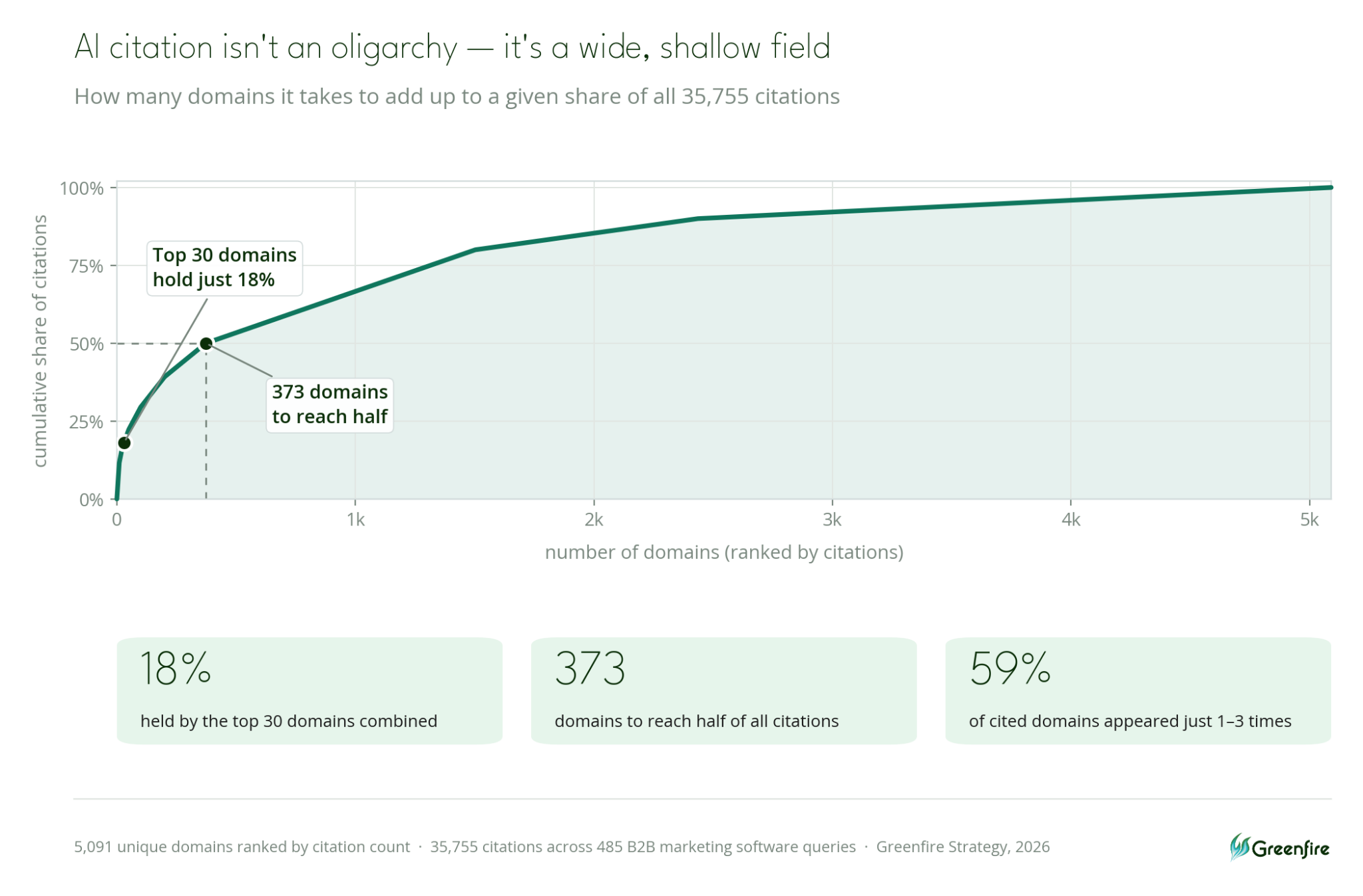
The study found that the top 30 domains accounted for only about 18% of all citations, and it took 373 domains to account for half of them. In other words, AI-generated answers are drawing from a remarkably broad range of sources. That’s important if you’re a smaller company with considerable competitors who have vastly more resources. Just because the big brands are getting cited doesn’t make everyone else irrelevant.
Is There Room for Smaller Companies?
The long tail of AI citations is full of smaller companies and less frequently cited domains. In our study, 59% of cited domains appeared only one to three times. This is one of the most encouraging findings in the study.
High domain authority can help with traditional SEO, but you don’t need to be one of the biggest domains on the internet to earn a place in AI-generated answers. In AEO, you compete for the questions where your company has something useful to say. That difference matters. Google itself notes that its AI features may use a query fan-out approach, breaking a question into multiple related searches and drawing on information from different sources to construct an answer. So, you can contribute to the answer without
“I wasn't entirely surprised to see HubSpot come out number one here, but I was shocked to see only 2% of those citations belong to HubSpot. And I think that's really exciting because if you thought that the only way to win at AEO was to have a big budget and a big team, I think you're wrong, because I saw a lot in the long-tail results. I saw a lot of small brands, small agencies, and teams of one or two that were able to show up in citations and hold certain topics. So there's a really cool opportunity here if you want to get in and establish yourself now in the early days of AEO.” -Tracy Graziani
Imagine a 12-person logistics software company that almost nobody outside its niche knows exists. Maybe the company has spent years helping manufacturers solve difficult inventory forecasting problems. The team knows this specific subject inside and out and wrote some content that answers questions that prospects actually ask, explains complicated concepts in a clear way, and provides information that other sources don’t cover as well.
The logistics software company isn’t going to publish hundreds of articles covering every possible business topic, and they don’t have to. They don’t need to own the entire logistics category. The company simply needs to become valuable in the places where their expertise matters. Like our imaginary logistics software company, you don’t have to own your entire topic either. That’s a much more attainable goal than trying to beat the huge brands.
Where Should A Small Team Start With AEO?
If you're a small B2B company, you probably don't have the resources to publish 500 articles about every conceivable aspect of your industry, and you don’t need to. Start by focusing on your customers.
What are they asking before they buy? What problems are they trying to solve? Where do they consistently need help? And, most importantly, what can you explain better than most companies in your space? That's a much more manageable starting point than “We need to rank for everything.” It also keeps your content tied to something that matters: your actual buyers.
“Okay, so where do you start? You start with your customers. You start with your prospects. You look at what problems they are going to an answer engine or a search engine for. In fact, think about it more in terms of a search engine, since we know that there's a direct correlation between organic search and AEO. What things are they looking for help with? And of those things, what do you uniquely solve really well? Start there.” -Tracy Graziani
Focus on the questions your buyers are already asking. Not the broadest, highest-volume topics you can find, but the specific things your buyers want to know. Look for the problems your company solves especially well, then build genuinely helpful content around those questions. A narrow area of expertise can be much more doable than trying to become the definitive source across an entire category.
There is a distinction worth keeping in mind regarding AI visibility: getting cited isn't the same thing as being recommended. There’s a clear difference between being cited as a source and being identified as the “best” or preferred option in an AI-generated answer. A citation means an AI system used your content as a source; it doesn’t automatically mean a conversion. That’s why you need to connect with your audience and have something actually beneficial to contribute. Consistently providing information that helps people understand a problem, evaluate their options, and decide helps you become a credible and expert authority.
You Don't Have To Beat HubSpot
HubSpot is clearly successful, and so are other big brands. There’s no questioning that. One of the best things about Greenfire's study, though, is that it shows that even the most-cited brand in the study represents only a small piece of the overall citation landscape. The data demonstrates that hundreds of domains contribute to the answers people receive, and smaller brands appear alongside much larger ones.
Ultimately, the question isn’t if you can beat HubSpot. You don’t have to. The question is if you give AI engines a reason to cite you. Your goal should be to become a helpful, credible source for the questions that matter to your customers.
Create the clearest explanation of a complicated process, concisely answer a question you often hear, publish original research, or present detailed guidance based on your company’s experience that your competitors don’t have. Find the problems your company uniquely understands, answer questions well, and build useful, specific content around your specialties. Build authority around the topics where you have mastery and stand out from the crowd.
Greenfire's Signal Fire Snapshot can show you how your brand is currently appearing across AI search and where there may be opportunities to build visibility. Want the bigger picture first? Download the full Greenfire Strategy AI Citation Study below.


Greenfire Strategy's resident wordsmith. Her relentless dedication to research, truly human touch, and word-slinging skills mean that all of the content that she creates is enjoyable, engaging, and effective.