

.jpg?width=1200&height=820&name=stefan-stefancik-5p_7M5MP2Iw-unsplash%20(1).jpg)

Which AI Engine Should You Optimize For? It Depends
(and how to actually leverage it)
AI search is quickly becoming one of the biggest topics of conversation in digital marketing. As platforms like ChatGPT, Gemini, and Perplexity continue to shape how buyers research solutions, marketers are looking for better ways to understand how their brands appear in AI-generated answers.
That’s exactly what HubSpot’s new Answer Engine Optimization (AEO) tool is trying to do. It’s one of the first major attempts to bring AI visibility data directly into a CRM. It provides valuable insights into where brands appear, how they’re described, and which sources AI platforms rely on to generate answers.
It’s an exciting new tool, but it’s only part of the equation. The dashboard can tell you what’s happening, but it can’t tell you why you’re getting those results or how to improve them. Understanding how to interpret the data that the tool provides is where the real opportunity lies.
What Is HubSpot's AEO Tool And Why Is It A Big Deal?
tl;dr: HubSpot’s new AEO tool measures how often brands appear in AI search results across ChatGPT, Gemini, and Perplexity, along with citations, share of voice, and sentiment. It matters because it puts AI visibility measurement inside the CRM you already use.
HubSpot’s new AEO tool was introduced into public beta on April 14th, 2026, during the Spring 2026 Spotlight. It’s an AI visibility tool designed to track how often ChatGPT, Gemini, and Perplexity mention and cite your brand. Instead of relying on guesswork, brands can track how they’re described, which sources get cited, and how often they appear in answers. It also generates actionable content and outreach recommendations to help improve that visibility.
The tool follows four key steps:
- Add prompts: Add the types of questions your target audience is likely asking AI tools.
- Run prompts: Each prompt is submitted about 10 times across ChatGPT, Gemini, and Perplexity to gather data.
- Analyze responses: The HubSpot AEO tool evaluates which sources are cited, what type of content is referenced, and if your brand is included in results.
- Generate recommendations: The tool creates a prioritized list of content, social, and outreach actions to boost visibility and also provide draft suggestions.
This tool is groundbreaking because it solves a new, high-stakes problem: potential leads are using AI chat tools to research brands before even visiting a website, and if your brand isn’t mentioned in the answers, you’re missing a crucial stage of the buyer’s journey.
According to HubSpot, qualified leads from AI-generated answers increased 1,850% between Q1 2025 and Q1 2026, and AI citations increased 433%. HubSpot also reported that leads from AI-generated answers converted up to 3x more than leads that came from traditional searches and that early adopters of the AEO tool saw an increase of 20% in AI-driven traffic after optimizing for AI visibility.
Before now, CRM-native AEO measurement hadn’t existed. Digital marketers have been forced to use multiple third-party tools to glean insights, sprawling across platforms. The new tool is built directly into HubSpot, putting AI visibility measurement inside the platform that marketers already use. The tool helps to turn visibility gaps into in-HubSpot tasks, shortens the research cycle, and allows you to tie AEO metrics directly to brands.
The HubSpot AEO dashboard is included for free for Marketing Hub Pro and Enterprise accounts, with Pro receiving 25 prompts and Enterprise receiving 50 prompts. It’s also available as a standalone tool for $50/month or $45/month with an annual subscription.
What Does HubSpot AEO Actually Measure?
tl;dr: It measures brand visibility, customer sentiment, share of voice vs. competitors, and citation analysis. Of the four, customer sentiment receives the highest weighting.
The AEO tool measures four metrics:
- Brand visibility: How often your brand is mentioned in AI answers for your tracked prompts and how your brand visibility has trended over time, broken down by AI engine. For example, if your brand is mentioned in 7 of 10 answers, your brand visibility score would be 70%. This metric helps you discover what percentage of prompts mention your brand and what trends are occurring.
- Customer sentiment: An NLP (natural language processing)-based measure of how positively or negatively your brand is described in AI responses and how your brand's sentiment changes over time across ChatGPT, Gemini, and Perplexity, highlighting shifts in tone and engine-specific trends.
- Share of voice: The percentage of total brand mentions your brand holds compared to competitors. It’s calculated as your brand’s mentions divided by all brand mentions combined, so shares across all brands equal 100%. For example, if your brand is mentioned 10 times, and other brands are mentioned a cumulative 90 times, your share is 10%. This is a relative metric; if competitors gain mentions, your share may decrease even if your total mentions remain unchanged. HubSpot’s AEO tool actually gives customer sentiment the highest weight (40 out of 100 possible points), which suggests that how AI describes your brand may matter more than whether you’re mentioned at all.
- Citation analysis: The websites that AI engines reference when generating answers. This includes both domains and URLs. Tracking which sites get cited most and whether your brand is mentioned in them is key to understanding and improving your visibility. This metric can help you see who AI is trusting and what sources are repeatedly appearing.
HubSpot’s AEO tool can also provide verbatim AI answers of the full text that engines return for each prompt, map the exact domains, pages, formats, and channels that AI engines cite, and show how often a specific competitor set appears for your prompts.
What Can't The HubSpot AEO Tool Do?
tl;dr: It only checks the prompts you load, doesn’t scan Google AI Overview or Claude, offers shallow citation analysis, and can’t win prompts for you. It doesn’t improve visibility, create authority, or fix reputation.
While it can provide valuable insights and context, every measurement platform has limitations. HubSpot’s AEO tool is no exception.
It only measures the prompts you give it
The AEO tool only checks the prompts you load into it on the dashboard, so it’s possible to get inaccurate data. For example, it can report 0% for brand visibility or share of voice while ChatGPT already names your company, simply because it didn’t scan for the right prompt. This means that it may not show you the true metrics of how well your brand is performing on AI platforms.
The tool checks about 25 prompts for Marketing Pro accounts and 50 for Enterprise accounts. Many of the generic, pre-populated prompts will give general answers without naming a specific company. This means your dashboard could read 0% even though you could be genuinely visible.
It doesn’t cover every AI engine
The AEO tool provides data for ChatGPT, Gemini, and Perplexity. It doesn’t include any information from Claude, Google AI overviews, DeepSeek, Microsoft Copilot, or voice AI like Siri or Alexa. The most concerning out of these is the lack of data from Google AI overviews, since it’s the most widely used AI system and source of zero-click traffic.
It can’t replace SEO
The new AEO tool can’t replace the data or foundation SEO provides, such as backlinks, SERPs, keyword volume, and domain authority. SEO has taken a bit of a backseat since the AI boom, but it’s still an integral part of digital marketing. AEO optimization helps AI engines understand and utilize your content, but SEO is the foundation that makes it visible in the first place. In fact, the authority, technical health, and relevant content that make up SEO overlap with what AEO utilizes. SparkToro also discovered that AI is highly inconsistent in recommending brands, so SEO can help drive traffic when AEO misses out.
It can’t fix your visibility
Think of HubSpot’s AEO dashboard like your car’s dashboard. It tells you what’s happening under the hood, but it doesn’t repair your engine or change your oil. It’s a diagnosis and not a cure. Like a car, sometimes it’s a simple fix. Other times, you need to call in a professional. Similar to a mechanic, AEO professionals have the expertise to identify the root causes of issues and determine the best course of action.
The tool can show you your AI visibility, but it can’t fix your AI visibility. It won’t rewrite your content process, strengthen your brand authority, or change how AI views your company. The insights from the AEO dashboard are only valuable if you use them to make informed decisions.
Is HubSpot AEO Worth It?
tl;dr: Yes, if you have Marketing Pro or Enterprise. Maybe, if you’ll use the insights. No, if you expect it to magically improve AI visibility.
HubSpot’s AEO tool is powerful, but like any tool, the value you get from it depends on how you use it.
If you already have a HubSpot Marketing Pro or Enterprise account, yes, the AEO tool is worth it. It’s included with your account, and CRM-connected measurement is worth having. It gives you the ability to tie mentions to opportunities, deals, and closed-won revenue within HubSpot and prioritize content that actually affects AI search results.
If you don’t have a Marketing Pro or Enterprise account, the tool is $50 per month, or $45 per month with an annual subscription. It’s a fair price if someone is willing to review the data and act on it. The tool provides insights, but doesn’t execute the plan for you.
If you’re expecting a content engine or magic bullet for AI visibility, you’ll probably be disappointed. It’s also not worth treating as your single source of truth regarding your AEO metrics. It doesn’t write content, publish posts, or guarantee top placements in AI-generated answers. HubSpot AEO gives you a clear view of where you stand and what to do next, but it’s up to your team to do it.
How Do You Actually Leverage HubSpot AEO?
tl;dr: Replace default prompts, study sentiment, earn citations, and write expert content.
HubSpot’s AEO tool is an excellent starting point, but it’s only the beginning. It helps you understand how AI platforms currently perceive your brand, but you need to use those insights to refine your marketing plan, content, and authority to align with what AI engines look for when generating answers. Ultimately, the tool doesn’t tell you how to become more visible, but rather where opportunities exist. It’s up to marketers to turn those insights into a cohesive plan.
Fix the prompt set first
One of the biggest mistakes marketers make is relying on the default prompts generated by the tool. While they’re useful when getting started, they’re very generic and often reflect marketing language instead of what buyers are actually searching.
You will need to rebuild your prompt set around real buyer conversations. Review sales calls, customer support tickets, FAQs, and discovery meetings to identify the questions your potential leads are actually asking throughout the buyer’s journey. Then, organize those prompts by awareness, consideration, and decision stages so you can understand how your brand appears throughout the journey. The more your prompts reflect real-life search behavior, the more accurate your insights will be.
Read sentiment as a strategy signal
Visibility tells you whether AI is mentioning your brand, but customer sentiment tells you what it’s saying. As mentioned previously, HubSpot puts the most weight on the sentiment score. How you’re mentioned is more important than whether you’re mentioned at all.
A high visibility score isn’t necessarily a win if AI describes your company as “expensive,” “difficult to work with,” “not ideal,” or any other negative descriptors. Those descriptors influence buyer perception long before they even visit your website.
Rather than focusing only on how often your brand appears, pay close attention to the language that AI uses to describe it. Recurring themes can reveal reputation issues, misconceptions, and communication gaps. These challenges can be addressed through stronger thought leadership, clearer positioning, customer success stories, and independent validation.
Win the citation, not just the page
Appearing in AI-generated answers matters — but the conventional wisdom about how you get there is mostly wrong. The prevailing advice says AI leans on trusted third-party coverage, so go earn authority off your own site. We tested that assumption across 35,755 citations, and the data pointed the other way: roughly three-quarters of what AI cited was companies' own content about themselves. The third-party "social proof" signals the industry optimizes for — community, video, social, reviews — came to about one citation in eleven, combined.
That reframes the work. AI citation doesn't run on authority the way a human reader recognizes it; it runs on ubiquity — being present, ranked, and current for the questions your buyers actually ask. Your own published content is the main event, not a supporting player. The lever isn't a credential the engine can't see; it's showing up, thoroughly and freshly, across the topics you want to be known for.
Third-party platforms still have a role — just a narrower and more honest one than they're usually sold with. Reddit, YouTube, and LinkedIn are among the most-cited domains on the open web, so a genuinely useful post there places your content on a domain the engines already lean on. But that's borrowed presence, not authority you own — a legitimate complement to the content you control, never a substitute for it.
"There's a lot of AEO snake oil being sold right now, and people are buying it because they've watched their traffic decline for years while being held accountable to KPIs that lean heavily on traffic. Measuring AEO is the first step, but impacting it is an entirely different approach than SEO. Here's the irony: most of what actually moves AI citation isn't the expertise or authority everyone's selling — it's ubiquity. Being present, ranked, and current for the questions your buyers ask. That's not a score you can buy. It's work, and it's work a small team can actually do." — Tracy Graziani, CEO, Greenfire Strategy
tl;dr: HubSpot's AEO tool is an excellent measurement tool. But measurement isn't strategy — and the tool's default next step, generating content with Breeze, is the weakest lever it could hand you.
One of the biggest misconceptions in AI optimization is that generating more content is the fastest path to AI visibility. When the HubSpot AEO tool surfaces a gap, the tempting move is to fill it with AI-generated copy. But we studied 35,755 AI citations, and the data is clear on this: volume of generic branded content isn't what gets you cited. Publishing more, faster, mostly adds noise.
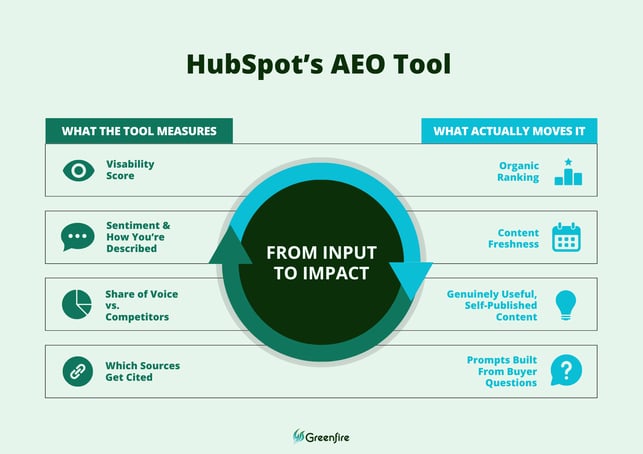
Here's what actually tracks with citation — and it's not what the industry sells. AI engines don't reward "authority" the way a human reader recognizes it; they reward ubiquity: being present, ranked, and current for the questions your buyers ask. In our data, the levers that predicted citation were organic ranking and freshness — not credentials, not author bios, not expertise markers, which showed no relationship to citation at all. So the fix for a gap the tool finds isn't "generate a page." It's "have genuinely useful content on that topic, make it rank, and keep it current."
That's exactly where AI-generated filler fails and human work wins — but for a sharper reason than "AI trusts humans more." It doesn't. The engine can't tell who wrote your page. Human expertise matters for the person who arrives after the citation: a real point of view, real examples, and earned trust are what convert a click into a customer. Interchangeable AI copy gets you neither the human's trust nor, on its own, the ranking and depth that earn the citation in the first place.
So use the tool for what it's great at — spotting where you're invisible — then do the work that moves the needle: cover the questions your buyers actually ask, rank for them, keep your best pages fresh, and make them worth reading for the human on the other side. Third-party platforms like Reddit, YouTube, and LinkedIn can extend your reach, because those domains are already citation-dense — but treat that as borrowed presence, not authority you own, and never as a substitute for the content you control. The tool tells you where the gaps are. Closing them is a strategy, not a "Generate" button.
How Does Greenfire Approach AEO?
tl;dr: HubSpot's AEO tool is the instrument, not the strategy. The value is in acting on what it measures — closing visibility gaps with content that ranks, stays current, and is worth reading.
HubSpot's AEO tool gives you a clear read on how your brand shows up across ChatGPT, Gemini, and Perplexity. But a dashboard diagnoses; it doesn't treat. At Greenfire, we treat the tool as the instrument and build the strategy around it.
We start by seeing how AI currently reads your brand. Our free Signal Fire Snapshot establishes a baseline — visibility, sentiment, and the aggregate sources AI pulls from — so we can see where you're present, where you're invisible, and where the opportunities are.
From there, the work follows what actually moves citation. We rebuild your prompt set around the questions your buyers really ask, then close the gaps the way the data says works: making sure genuinely useful content exists on those topics, that it ranks, and that it stays current. A Signal Fire Activation puts that plan in motion — not by generating filler, but by earning presence for the questions that matter to your buyers, and keeping it fresh over time.
Human expertise is central to that work — just not as a trick to move the engine. The engine can't see credentials. What real expertise does is make your content worth reading for the person who arrives after the citation, and worth trusting once they're there. That's what turns visibility into pipeline. The tool measures where you stand; the work — ranking, freshness, coverage, and content actually worth citing — is what moves you.


Greenfire Strategy's resident wordsmith. Her relentless dedication to research, truly human touch, and word-slinging skills mean that all of the content that she creates is enjoyable, engaging, and effective.