



Retargeting Strategies That Actually Work Today
The main concept behind account-based marketing (ABM) has always been “relevance wins”. Marketing campaigns that address the needs, challenges, and priorities of a certain target prospect will be more engaging, and personalized sales outreach tends to accelerate sales cycles. However, with the changing technology in marketing, relevance is beginning to blur into something different. Marketers can now learn about their prospects in detail beyond our imagination, using data platforms, intent signals, AI-powered personalization engines, and dark-funnel tracking. Theoretically, a higher level of personalization leads to more useful, customized campaigns. In practice, however, there is such a thing as being too personalized. There is a fine line between relevancy and overreach, and it can be easy to cross.
So where is the line? When does personalization become predatory? When does research become surveillance? When does crafting a tailored campaign become psychological manipulation? Questions like these are at the heart of modern account-based marketing strategies. Personalization fuels ABM, but how marketers gather and use data has real ramifications for trust, privacy, and long-term brand reputation.
What Is Personalization In ABM?
Account-based marketing is essentially the opposite of conventional demand generation. ABM begins with a list of identified target accounts and creates campaigns tailored to them, rather than marketing broadly and hoping the right buyers will appear. Marketers need to know much more about their audience, and they do so by examining industry trends, company activities, leadership priorities, and behavioral cues to develop messages that appeal to specific target organizations.
Personalization Can Take Many Forms Within An ABM Strategy:
- Tailoring messaging around industry challenges
- Referencing a company’s strategic priorities or recent initiatives
- Creating content designed for a specific segment of decision makers
- Delivering campaigns across multiple channels where the audience is already active
When applied carefully, this comes across as thoughtful instead of inauthentic. The content is grounded in the prospect’s environment, addresses specific concerns, and acknowledges the complexity of their decisions. But the advanced state of modern marketing tools has made this process much more granular than before. When it’s not used tactfully, the highly detailed, highly specific data needed to craft an ABM strategy can feel intrusive compared to the broadly gathered aggregate data used in other marketing methods.
How Is Data Used In ABM Strategies?
Marketing teams use various sources of information to learn about their target accounts and define their messages. Some of this information is easy to access and publicly available, such as company size, financial trends, employment patterns, and executive announcements. Additional insights are collected through marketing technology platforms that monitor online behavior. Intent data enables marketers to see which companies are researching a particular topic or solution, and website analytics help them see how visitors interact with content. Industry publications, webinars, and digital communities are analyzed through audience research platforms. Combined, these data sources can help marketers create a behavioral profile to identify which accounts are actively considering solutions and what interests them most.
When used wisely, this information helps brands provide the right content at the right time. It eliminates unnecessary outreach and streamlines marketing on both ends. However, there is growing concern about the extent to which organizations can see a buyer's behavior before actively engaging with a brand.
Buyers do a great deal of research before they even talk to a vendor, but vendors are gaining access to technology that can show them some of that research process. This previously inaccessible data is part of the dark funnel, but it’s becoming increasingly visible. That visibility raises an uncomfortable ethical question: is it an invasion of privacy, or can it be morally neutral? Should businesses reveal what they know about a prospect's behavior, or silently use it to influence their approach?
The Impact Of AI On Personalized ABM Strategies
As AI becomes more integrated into ABM platforms, questions surrounding AI transparency and the ethics of personalization grow even more complex. AI-powered tools can now identify leads that align with target personas, analyze sentiment, and generate outreach recommendations based on behavioral cues. While this can be incredibly beneficial for targeting precision and ROI, it also introduces new ethical and regulatory considerations.
For example, the European Union’s AI Act, which has been rolling out in phases since 2025, prohibits the use of tools capable of emotional manipulation or exploitation. The thought behind this is that AI could be trained to use subliminal, manipulative, or deceptive tactics through reinforcement learning.
Businesses are currently able to use tools that can infer the emotions of their customers, but these will be subject to additional restrictions under the AI Act starting in August 2026. These new regulations could have an impact on the ability of businesses to use AI in sentiment analysis, personalized recommendation engines, biometric-powered capabilities, or predictive modeling, as they will be subject to more thorough investigation and scrutiny. Additionally, certain AI-generated content will need to be clearly indicated as such, which may impact the use of AI-powered prospecting tools. Compliance with the EU General Data Protection Regulation (GDPR), EU consumer protection law, and the EU Digital Services Act (DSA) can help avoid infractions under the AI Act, but offer no guarantee of eliminating the risk of violations when using AI for targeted marketing to an EU audience.
In contrast, U.S. data privacy laws remain relatively flexible and leave the discretion mostly up to companies as to how they use AI-driven insights. This growing divide highlights the importance of transparency, consent, and legality when handling data, AI, and ethics. As laws are added and amended both in the United States and abroad, it’s crucial to understand they may have broader implications than you'd expect. Beyond the legal implications, it’s a matter of moral responsibility not to be manipulative or misleading despite having more tools and data at our disposal than ever before. We have to be mindful of what data we use for AI input and the output it provides.
Is Targeted Marketing Ethical?
On the one hand, the personalization of ABM is a logical evolution of marketing. Businesses have continually attempted to know their customers and adjust their communication to suit them. ABM just adds additional structure and information to that process.
On the other hand, the scale and depth of modern data collection present new risks. The reaction is not always positive when buyers learn how much information businesses might have about their behavior. Campaigns that mention incredibly specific information about a company or person can easily become intrusive rather than relevant.
“Ethical concerns from targeted marketing can come up when you don't own the data you're using,” said Tracy Graziani, Founder & CEO of Greenfire Strategy. “One of the most valuable things that everyone should focus on is moving more in the direction of first-party data, because you can set your own standards around ethics, around how you collect first-party data, and how you communicate that with your clients and customers. And there's a lot more ability to control how safe and appropriate what you're doing is.”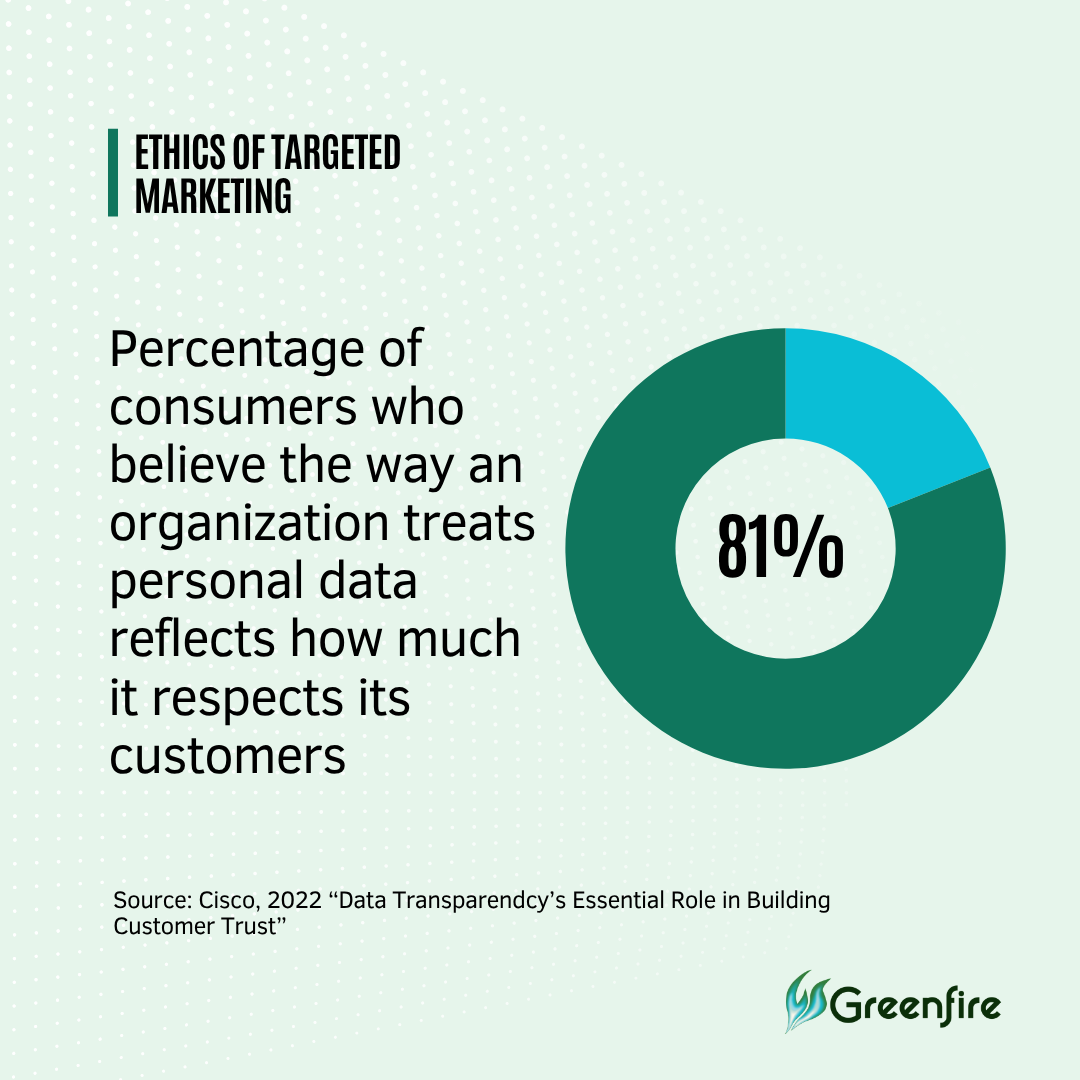
The ethics of targeted marketing often come down to intent, transparency, and trust. According to Cisco’s Data Transparency research, 81% of respondents believe the way an organization treats personal data reflects how much it respects its customers. That statistic highlights a crucial yet often overlooked point for marketers. Data practices shape how a brand is perceived. If a campaign feels manipulative or invasive, the damage to trust can outweigh any short-term conversion gains.
Tracy further elaborated on the importance of transparency. "We learned with Cambridge Analytica that third-party data providers buying and selling data has some very dangerous outcomes. Another newer ethical issue, in my opinion, comes from OpenAI's new in-chat ads. The information that AI chatbots have about us, that we've freely given to it, is often far more vulnerable than any ad targeting data we've ever exposed ourselves to in the past. AI has been able to prove that it can simulate empathy, and it can manipulate and influence human behavior. Those qualities, to me, make it unethical to have in-chat ads in the way that OpenAI is rolling out their ad product."
Levels of ABM Personalization: How Far Is Too Far?
If you feel that ABM can be ethical, how can it be implemented in a way that doesn’t make anyone feel violated? When considering the ethical limits of account-based marketing personalization, several areas warrant special attention.
The distinction between addressing an organization with industry challenges and adding very specific personal information to the campaign message is profound. The first approach reflects understanding the prospect’s situation. The second can range from invasive to creepy.
ABM often relies on multi-channel “surround sound” campaigns. Prospects may see ads, receive emails, encounter tailored content on websites, and interact with social media campaigns in an orchestrated, coordinated sequence. When done carefully, this supports positive messages across various touchpoints. When done excessively, it may seem that a brand is stalking a person online or being coercive, which can lead to negative reactions from the target, such as blocking the brand or making a viral video about the experience.
So what should you do? Ask yourself one question: “Would the prospect expect me to know this information?” If the answer is no, you may need to reconsider the course of action.
"Good ABM should feel like insight, not surveillance. Like you’re paying attention, not listening in on private conversations. People appreciate feeling seen, but personalization has to feel thoughtful and considered. Otherwise, it stops building trust and starts feeling creepy." -Amanda Natividad, Chief Evangelist, SparkToro
Personal Details In Campaign Assets
With hyper-personalization tools, individual names, job titles, and internal company initiatives can be directly added to marketing materials. This amount of specificity may feel awkward, too familiar, or even creepy in certain instances.
Tracy once had an experience where personalized marketing went awry. "I once received an email from a guy who asked me if I liked to eat at a certain restaurant that was really close to our office. And that weirded me out. It made me feel like he was stalking me, not that he was being friendly."
It’s often better to focus on the prospect's overall challenges rather than on one specific person. It’s one thing to target a company, and another to target a particular executive in a campaign that seems to know far too much about them. It may draw attention, but not necessarily positive attention.
Using Ethically Sourced Marketing Data
Data sources can vary in their ethical and value frameworks. Some marketing platforms collect information through dubious methods or from unverified sources. Using data insights without knowing how they were collected can put organizations at risk of privacy breaches and reputational damage, as well as the data’s questionable accuracy.
Marketers must also avoid exploiting sensitive information discovered during research. For example, mentioning a company's financial hardships or recent layoffs in a campaign to win them can come across as predatory and insensitive. Although certain information is available, it doesn’t mean it should be deployed as a marketing lever.
“Too far is exploiting people's vulnerabilities to cloud their judgment and manipulate their behavior." — Tracy Graziani
Ethical ABM Best Practices
Account-based marketing doesn’t have to conflict with ethical practices. When done well, ABM builds credibility and reinforces trust since it reveals sincere knowledge of a prospect’s situation. It also piques curiosity and generates interest since it's meant to speak to a prospect's specific pain points. We're all inundated with a constant stream of advertising and generic emails in this age, and it's harder than ever to stand out. The spray-and-pray method of marketing doesn't work anymore, especially when you're B2B. When done ethically, ABM is made to resonate with your prospects without overwhelming them or overreaching. It cuts through the clutter to offer genuinely helpful solutions.
Be responsible with first-party insights.
Using first-party data from similar companies to understand your prospect’s behavior and the platforms they frequent can offer valuable insight, but it may not always be reliable or transparent. Data collected directly through interactions with your own content, events, or platforms provides valuable signals about audience interests. There's a continuum of personalization. On one end, there is someone sending you a generic pitch trying to sell your own services back to you, showing they have no clue what you do. On the other are hyper-personalized messages that contain information you wouldn't expect a stranger to know, that make you feel like they're waiting outside your office to follow you to lunch. The sweet spot of personalization is somewhere in the middle.
Leverage anonymized audience research.
Many research tools examine and analyze aggregated behavior among industries and professional communities. Since the data is anonymized, marketers can find patterns without revealing individual users. For example, the audience research tool Sparktoro uses aggregated data to understand user behavior without revealing overly-personal information about individuals.
Avoid excessive hyper-personalization.
Relevance should add to the buyer’s experience, not make them feel spied on. Concentrate on common problems, shared challenges, industry trends, and company interests instead of specific personal information.
"To me, good ABM is when your marketing makes people curious and leaves them wanting to know more. It makes people drawn to you, not repelled by you. That's what good ABM should do, especially because in ABM, you're often selling to people who resist being sold more than the average person." — Tracy Graziani
Be thoughtful about how AI is used in personalization.
Artificial intelligence can radically increase the creation of customized materials and insights. However, marketers need to carefully examine AI-generated messages to ensure they don’t violate ethical principles and align with your brand voice. It is imperative to note that different regions may have different rules and regulations as well, which can add another layer of complexity to ABM .
Prioritize empathy in campaign strategies.
The most effective ABM campaigns aren’t only about finding sales opportunities. They demonstrate comprehension of the strains, problems, and choices faced by business leaders.
When created with empathy, personalization becomes supportive instead of intrusive. Your brand becomes a trusted leader instead of a questionable nuisance.
Personalization will remain a key element of account-based marketing. Buyers expect relevant, credible content and valuable insights to help them make effective decisions. However, marketers also face new responsibilities. The technology and tools that facilitate hyper-personalization require marketers to think about their obligations to ethics and empathy.
Businesses that use data to serve their prospects rather than manipulate them, and see information as a privilege rather than an entitlement, will succeed with ABM in the long run. It’s not just a matter of whether a campaign can be personalized, but rather if it should be and to what extent.
Want more insights like this? Sign up for the free Greenfire Strategy ABM Swipefile to stay up to date on ABM marketing strategy, ethical development, and the role of empathy in the B2B marketing dynamic, and get your free Signal Fire Snapshot to see how your business stacks up in the age of AI.


Greenfire Strategy's resident wordsmith. Her relentless dedication to research, truly human touch, and word-slinging skills mean that all of the content that she creates is enjoyable, engaging, and effective.

